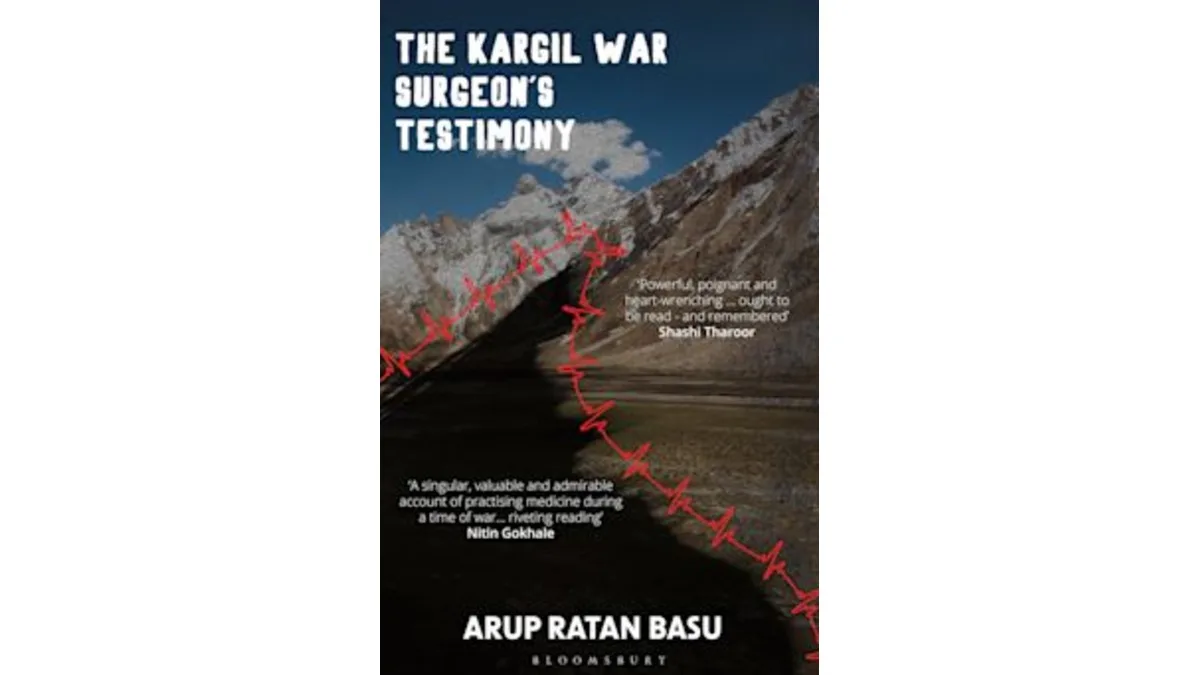
The Kargil War Surgeon’s Testimony written by Arup Ratan Basu is a vivid picturesque record of his journey as a young surgeon to the valley of Kargil during the conflict of 1999. Books on the Kargil War have been plenty and abundant in the last decade. This book stands as an exception in the sea of war testimonies. Published by Bloomsbury this year, the book has a personal touch, the feelings of frustration and empathy, a sense of wonderment, and a descriptive backdrop of Kashmir.
Basu writes, “Some villagers stared at the passing military vehicles with suspicion clear on their faces. Their eyes seemed to reflect their inner despair and hopelessness.” This is the description of the people of villages of Kashmir and the initial shock of the cultural and historical background for the new surgeon in an alien land. In the author’s note Basu adds, “I had bought an ordinary hardbound notebook at the town bazaar to note my experiences during my stay in Kargil. In spite of the demands of my work, I managed to note the most important events of the time.” Hence this book serves as a personal journal, more epistolary than non-fiction prose. Small notes on the historical background helps the reader in understanding the lore of the land better.
Advertisement
Shashi Tharoor reviewed the book as, “In Basu’s view, it’s not so much about the futility of war as its untold human cost, which gets muffled beneath the nationalistic pomp and clamour of any war effort-even one like Kargil, undertaken in self-defense.” The book starts with physical descriptions of the journey of a surgeon and his first posting as a Medicorp for the Indian army. Basu writes, “I was a bit apprehensive but I reminded myself that fear was equivalent to death, an idea made popular by the villain Gabbar in the movie Sholay.” This is in response to his initial duties as a surgeon for the war wounded, a doctor with just one month of experience. The story revolves around a common man who rises up to the occasion when his country needs him. The doctor received the Yudh Seva Medal for his valiant efforts in the war.
The seriousness of shelling and mortality of war are very subtly given breaks with chapters like “Celebrities”. Basu writes, “The purpose of their visit was to greet the wounded soldiers and boost their morale by talking to them for a while…Shabana Azmi and Javed Akhtar seemed particularly interested in seeing the conditions the soldiers had to live and work in… Most soldiers expressed their desire to go back to the front and fight. Their spirit seemed to greatly impress the stars. I noticed Sunil Shetty even wiping tears from his eyes.”
The novel seems surreal in places when the human condition and the inevitable loss war brings is juxtaposed with such extravagant events of empathy and resilience. There are strong after taste of war and the innumerable loss it brings to the civilian lives, but there are no overtly romantic notions of the war. Basu makes sure it is a journal, and does not provide any sides to it.
The gruesome effects of war and the trauma of a doctor treating his patients under a severely haphazard manner has been written in such a conversational tone that it makes the reader feel the harrowing effects of war. Accounts of bizarre injuries also find a place in the book.
The last chapter titled “The Suru’s Eternal Flow” is philosophical, almost prophetic of a man who has seen death in his private space and come out alive. Basu records dialogues between the lost lives and the river, and it is such profound pathos, the reader is reminded of the indescribable guilt of a survivor. Basu does a great job of recording the whole war just as it was; it is raw, unfiltered and surprisingly not accusatory.
Spotlight
The Kargil War Surgeon’s Testimony
By, Arup Ratan Basu
Published: Bloomsbury, 2025
185 pages, Price: 399